Why you feel poor when you have money and what helps
Feeling poor while earning well has more than one cause. What each one is, how to tell when the feeling is right, and what fixes it.
Published

You pay your bills. There is something in savings, maybe a pension, maybe a home you are paying off. The numbers say you are doing fine. And still, at the checkout or when friends plan a dinner out, a quiet voice says you cannot afford it.
That feeling is real, and it is rarely about how much you earn. It usually comes from one of a few places: an income that leaves nothing behind, a month with no plan, a total you have never seen, or comparisons with people whose debts stay hidden. And sometimes it is right, because money really is short.
Each of those has a fix, and the sections below take them one at a time.
The feeling is real, and it has more than one cause
Feeling poor is not imagined. It is the pause before every purchase, the dinner you skip while friends go, the sense that one wrong move would empty the account. Being told the numbers look fine does not make it go away. The feeling is pointing at something, and the work is finding out what.
It is rarely about income alone. People who earn well feel it too, and many people misjudge where they stand. A study in Sweden found that a vast majority believed they were poorer, compared with others, than they really were. In Buenos Aires, researchers traced the same kind of error to one habit: people picture everyone's money from the few people they know.
You earn well, but nothing is left
A bigger income tends to bring a bigger life. Each raise arrives with a better home, a newer car, a nicer holiday. None of it feels like overspending, because each step is small and each one is earned. But at the end of the month the account looks the same as it did years ago, and so does the feeling.
What you hope for rises with what you earn. A study in Switzerland found that the income people aspire to rises with their own income and with the incomes around them, and that higher aspirations go with lower satisfaction. A raise moves the bar along with it.
Fixed costs fill the space. Rent or a mortgage, insurance, subscriptions, childcare: the costs that leave before you decide anything grow quietly, and take the room each raise made.
Save first, then spend the rest. The fix is to decide what you save before the month starts, and move it on the day pay arrives. What remains is yours to spend without guilt. A savings target calculator finds an amount you can actually save, from your income and your essentials.
Every purchase feels like a guess
Without a plan, the safe answer is no. When nothing says how much this month can spend, every purchase is a question answered from memory and mood. Small ones slip through, bigger ones set off the worry, and spending never feels settled.
A budget answers before you ask. A budget is a plan for the month: what comes in, what is already promised to bills and saving, and what is left. That last figure, what is left to spend, is the one that matters at the checkout. If a purchase fits inside it, you can afford it, without doing the maths in your head.
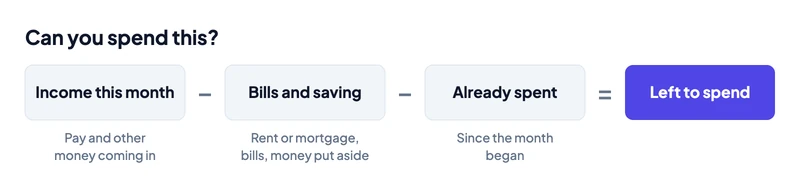
It works as permission, not a cage. With the bills and the saving covered first, what is left can be spent freely. Knowing the dinner out fits turns it into a pleasure instead of a worry.
You have never seen your whole picture
Most people never add it up. Money lives in many places: an everyday account, a savings account, an investment app, a pension statement that arrives once a year, perhaps a home or a car, perhaps an account in another country and another currency. Each has its own login, its own statement and its own timing. Few people ever put them on one list.

Without the total, the feeling fills the gap. What you notice are moments: the account near the end of the month, a large bill, a payment that left earlier than expected. Those moments are the low points by design. Pay arrives once, and spending leaves all month long. Judging what you have from them is like judging the weather from the coldest hour of the night.
Saving first hides money from view. Saving first is the right habit, and it has a side effect. Money moved to savings or a pension the day pay arrives is money you stop seeing. The more steadily you save, the smaller the account you look at every day, and the poorer you can feel while doing exactly the right thing.
Net worth is the whole picture in one number. Everything you own, minus everything you owe: accounts, savings, investments, pensions and the value of a home or a car, minus the mortgage, the loans and the cards. Counted on one day, in one currency. For many people it is far larger than the account they look at most. You can guess yours, then count it, in about a minute.
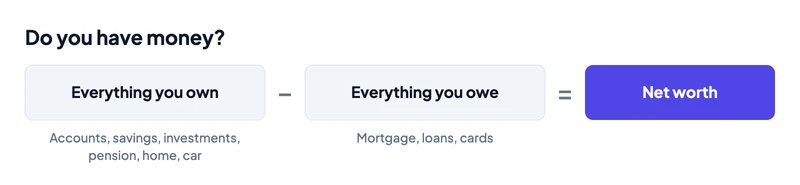
Then watch it move. One look helps. Looking again every month helps more. A single number can still feel small, but the change over time shows what a snapshot cannot: savings building, a mortgage shrinking, a pension growing in the background. Markets will pull it down in some months. Over a year or more, the line tells you whether you are moving forward, and that is evidence a feeling cannot argue with.
You see what others spend, not what they owe
Comparison runs on half the information. You see a neighbour's new car, a friend's holiday, a colleague's new kitchen. You do not see the loan behind the car, the card balance after the holiday, or what they have, or have not, put aside. Spending is visible. Saving and debt are not. Measured that way, anyone who saves looks like they have less.

It weighs on people, whatever they earn. A study in the United States found that people whose neighbours earned more reported being less happy, even when their own income was the same. What others seem to have changes how our own money feels.
Compare with numbers, not with feeds. Social media shows other people's best moments, not their bank statements. The comparison that tells you something is with the numbers of where you live. If your country's statistics office or a research institute publishes how incomes are spread, find where your household's income sits on it. For many people the answer is higher than the feeling suggested: as the study in Sweden found, most people place themselves lower than they really are. Seeing that you are doing well can be a relief in itself.
Doing well does not make the feeling wrong. It still deserves a fix. But if you stand well, the cause is rarely the income. It is the plan, the picture or the comparison, and those are exactly the parts you can change.
Not keeping up hurts, and that is real. Skipping the dinner your friends go to is not a small thing. One question helps: is it a limit or a choice? If the month has room and you still say no, the worry is the problem, not the money. If it has no room, you chose something else with that money, a home, a child, a cushion, and that choice deserves to be seen as one.
Spend on purpose. Money spent on what you care about, and cut from what you do not, feels different from money spent to keep up. Other people will always spend on things you do not. That is their plan, not your measure.
When the feeling is right
Sometimes the feeling is telling the truth. Before talking yourself out of it, check three things:
- You spend more than you earn. Month after month the account ends lower than it started, or a card covers the difference.
- Your debt is growing. What you owe on cards or loans goes up instead of down.
- There is no cushion. A surprise bill, a repair or a few weeks without pay would have to go on a card.
If one of them is true, act on it. The feeling is doing its job: it points at something to change, not something to see differently. Start with the one that is true. A debt payoff planner compares ways to clear what you owe, and an emergency fund calculator sizes a cushion from your own monthly costs.
If none of them is true, the feeling is most likely coming from one of the places above, and each of those has a fix you can start this month.
Keeping it all in one place
A plan for the month, what is left to spend and your net worth can all live in a spreadsheet, and that is where many people start. The work is keeping it current: a pension statement here, an exchange rate there, a month of spending to add up.
Valunto keeps all three together, across every account, asset and currency, for you alone or for a household together. You can see how it looks with a sample household first, or get started with your own. The net worth guide shows how the whole picture is built.
What to take with you
Feeling poor is a signal, not a verdict. The feeling is real, and it rarely means what it seems to. Most often it comes from an income that leaves nothing behind, a month with no plan, a picture never put together, or a comparison with what others choose to show. Each cause has its own fix:
- If nothing is left at the end of the month, decide what to save before it starts.
- If every purchase feels like a guess, give the month a plan and know what is left to spend.
- If you have never seen the whole picture, add up your net worth and watch it over time.
- If comparing weighs on you, compare with numbers instead of feeds, and spend on what matters to you.
- If money really is short, start with the debt or the cushion.
Most of it needs no bigger income and no big change. It needs one number you trust, then the next. Start with the one that sounds most like you.
Sources
- Richer (and Holier) Than Thou? The Effect of Relative Income Improvements on Demand for RedistributionMounir Karadja, Johanna Mollerstrom and David Seim. The Review of Economics and Statistics, 2017
- Biased perceptions of income distribution and preferences for redistribution: Evidence from a survey experimentGuillermo Cruces, Ricardo Pérez-Truglia and Martín Tetaz. Journal of Public Economics, 2013
- The role of income aspirations in individual happinessAlois Stutzer. Journal of Economic Behavior & Organization, 2004
- Neighbors as Negatives: Relative Earnings and Well-BeingErzo F. P. Luttmer. The Quarterly Journal of Economics, 2005